Panormos
In ancient Greek, «pánhormos» literally means "a harbour for every wind", and it is no coincidence that the inhabitants of ancient...
Updated 8 July 2026
This season · July · Summer
What to do in Panormos now
The story
The story of Panormos
A name that is already a description
The place name Panormos comes from the Greek compound pan (all, every) and hormos (anchorage, harbour), and simply meant a safe landing whatever the direction of the wind — a practical definition, typical of ancient maritime toponymy, found identically in several other harbours around the Mediterranean. Here, however, the name became tied to a specific destiny: already in the Archaic and Classical periods the bay served as the natural port for Eleutherna, a Dorian city-state traditionally founded by settlers from Sparta, which between the 8th and 4th centuries BC became one of the most influential centres of north-central Crete, with its own mint and trade links reaching as far as the Aegean and Italy. Without direct access to the sea, Eleutherna depended on Panormos for exporting oil, wine and pottery and for receiving goods from abroad: a close bond between hill town and coastal harbour that would shape the place's history for centuries, well beyond the end of Cretan political independence.
Byzantines, Genoese and Venetians: the layers of a long history
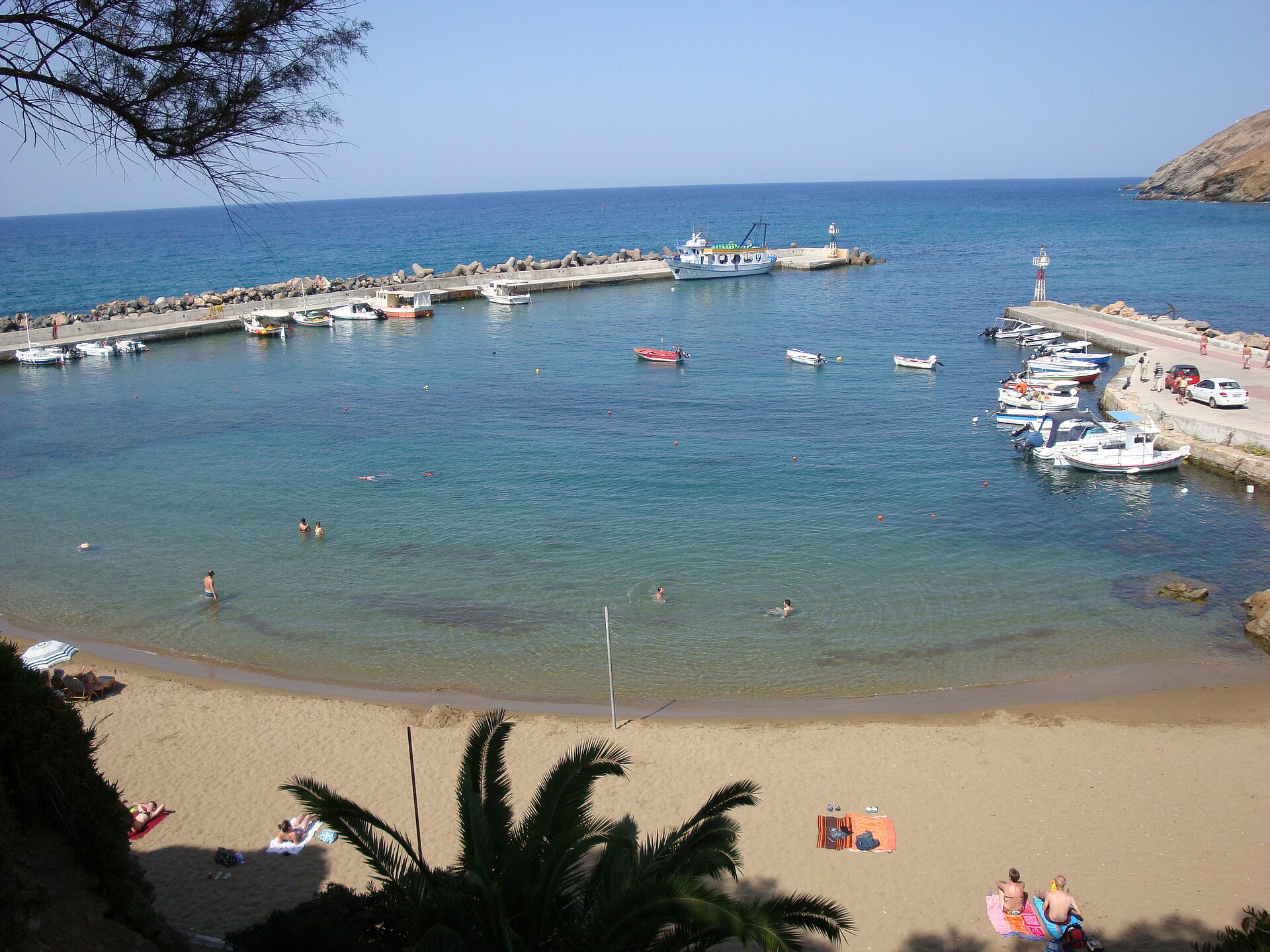
With the Roman conquest of Crete in 67 BC and then the long Byzantine era, Panormos did not lose its role as a harbour — quite the opposite: it was precisely in the early Byzantine period, between the 5th and 6th centuries, that the village gained a great Christian basilica, testimony to a settlement that was anything but marginal. After the Arab conquest of Crete in 824 and its subsequent Byzantine recovery in 961, the island came under Venetian rule from 1211, and the northern coast, exposed to pirate raids, was dotted with small towers and defensive forts. It was in this context that the powerful Kallergis family — a Cretan house of Byzantine origin that managed to preserve influence and privileges even under Venetian rule, after having led more than one revolt against Venice — had a fortification built on the small headland closing off the bay, to guard the landing place. With the fall of Crete to the Ottomans, completed in 1669 after the extremely long siege of Candia, the area lost its strategic weight and Panormos shrank to a simple fishing village, a role it essentially kept until well into the 20th century, when tourism began bringing life and economy back to the coast.
The Early Christian basilica of Agia Sofia
A little above the main beach, among the olive trees, lie the remains of what was once one of the largest and most elaborate Early Christian basilicas in all of Crete: the church of Agia Sofia, built between the 5th and 6th centuries on a three-aisled plan marked out by columns, with a narthex and a freestanding baptistery — a sign of the wealth and importance of the local community in Byzantine times. Probably destroyed by an earthquake and then by the 9th-century Arab raids, the basilica was never rebuilt to its original size, but its remains — column bases, traces of the flooring, perimeter walls emerging from the grass — can still be visited freely today, just a few steps from the sea. It is a place that strikes precisely for the contrast between the monumentality one senses from the size of the plan and the absolute quiet in which it is immersed: no ticket, no crowds, only the rustle of the olive trees and, in the background, the sea just metres away.
The castle on the headland and today's little harbour
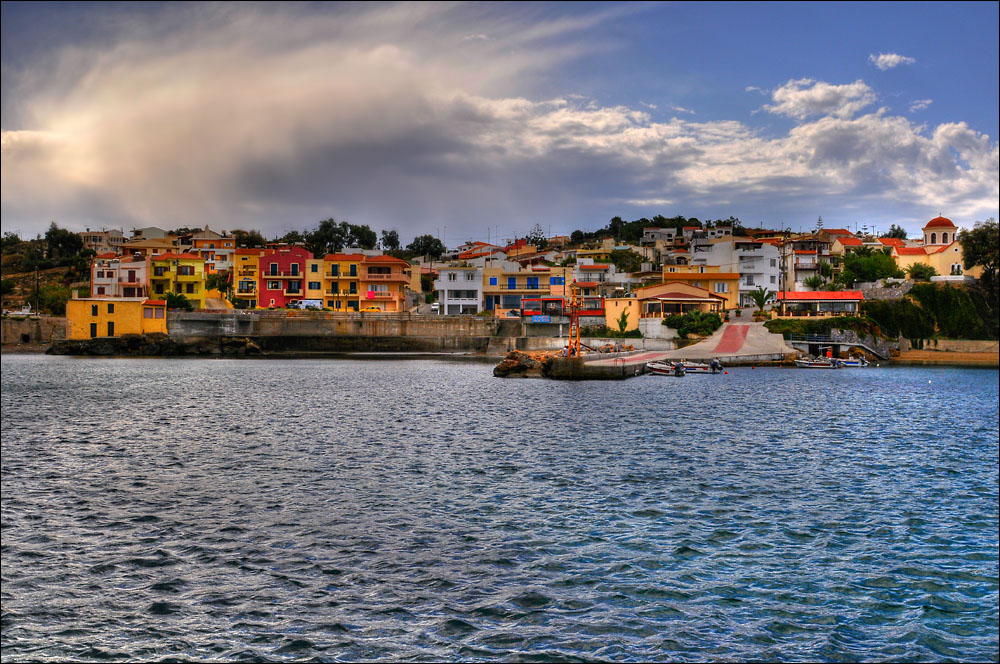
On the rocky headland east of the bay, where the fortification built by the Kallergis family in Venetian times once stood, today mostly stretches of wall and the outline of its base remain — enough, however, to convey the strategic sense of the site: from here the eye commands the whole inlet and much of the coast towards Bali. At the foot of the headland opens the small harbour, the practical and social heart of the village: a short pier, traditional fishing boats painted in bright colours, nets laid out to dry, and a row of taverns that in the evening look straight out over the water. It is a scene that has retained a rare authenticity for Crete's northern coast, less built-up than many nearby resorts: the houses are low, recent buildings have blended in without upsetting the village's scale, and strolling between the harbour and the basilica remains a human-scaled experience, far from the more concentrated tourism of Rethymno or Chania.
Beaches, sea and coastal landscape
Panormos's main beach stretches right below the village, with pale sand mixed with fine pebbles and a seabed that shelves gently, ideal even for families with small children. Moving along the coast, both west and east, small, less crowded coves open up, often reachable only on foot or by boat, where Mediterranean scrub comes down almost to the water's edge. The sea here keeps the typical colours of Crete's northern coast, a turquoise that turns deep blue just a few metres offshore, and is generally calmer than the more exposed stretches of the island, protected precisely by that "harbour for every wind" shape that gave the village its name. Behind the coast the land rises quickly towards the hills of Mylopotamos, covered in olive groves and terraced vineyards, creating a landscape in which the blue of the sea and the silvery green of the olive trees follow one another seamlessly all the way to the first foothills of the Ida massif.
Surroundings: Eleutherna, Margarites and Mount Ida
About ten kilometres inland, among the olive trees of the Prines hills, you can visit the excavations of ancient Eleutherna, systematically investigated since the 1980s and now told through a modern archaeological museum opened in 2016: a necropolis, public buildings and a Roman bridge tell the story of a city inhabited almost continuously for more than two thousand years. A little further south lies Margarites, a village of potters that carries on a clay-working tradition going back to Byzantine times, with workshops where you can still watch the potter's wheel in action. Behind this area rises Mount Ida (Psiloritis), Crete's highest peak at 2,456 metres, which in Greek mythology housed the Idaean Cave where, according to legend, Rhea hid the infant Zeus to save him from his father Cronus: a place for hiking and silence that, on clear days, offers views stretching from the Aegean Sea to the Libyan Sea. A few kilometres to the east, finally, the village of Bali offers further striking coves for those wishing to extend their exploration of the coast.
- Strolling at sunset between the little harbour and the ruins of the Agia Sofia basilica
- Swimming in Panormos's sheltered bay or in one of the more secluded coves nearby
- Visiting the excavations and the archaeological museum of Eleutherna
- Watching the potters at work in the traditional workshops of Margarites
- Hiking up Mount Ida to the Idaean Cave
- Dining on fish at one of the taverns on the pier, watching the boats come home
Flavours, traditions and when to visit Panormos
Panormos's cuisine is that of the Cretan hinterland brought to the table: olive oil pressed from the surrounding groves, cheeses such as graviera and myzithra, land snails (chochlioi) stewed, baked lamb and goat, wild herbs gathered in the fields, and a glass of raki almost always offered at the end of a meal as a gesture of hospitality. The taverns on the harbour mainly serve the day's catch, while inland there are still inns tied to the rhythms of farming and herding. As for the best time to visit, spring (April–June) brings mild temperatures and flowering countryside, excellent for excursions to Ida and Eleutherna; summer (July–August) is the beach season par excellence, livelier but never reaching the crowds of the island's big tourist resorts; September and early October keep the sea warm and the days long with fewer visitors, the preferred choice for those seeking a more relaxed pace.
FAQ
Come si arriva a Panormos?
Quando è il periodo migliore per visitare Panormos?
Cosa si può vedere a Panormos in una giornata?
Dove si parcheggia a Panormos?
Panormos è adatta a famiglie con bambini?
Quanto tempo conviene restare a Panormos?
Getting there
- Aeroporto di Eraklio «Nikos Kazantzakis» (HER), circa 48-55 km
- Aeroporto di Chania «Ioannis Daskalogiannis» (CHQ), circa 95 km
- Panormos si trova sulla strada costiera settentrionale (Nuova Strada Nazionale) tra Rethymno e Eraklio; da entrambe le direzioni è ben segnalata l'uscita per il villaggio.
- L'auto a noleggio è praticamente indispensabile: non esistono treni a Creta e i collegamenti bus verso i villaggi dell'entroterra come Eleutherna e Margarites sono limitati.
Perfect for
Una baia riparata con spiaggia di sabbia e ciottoli, ideale per un bagno tranquillo lontano dalla folla.
Dalla basilica paleocristiana al vicino sito di Eleutherna, un concentrato di storia cretese su poche centinaia di metri.
Le pendici del monte Ida e la grotta idea offrono escursioni per chi vuole alzarsi sopra il livello del mare.
Taverne di pesce sul porto e cucina di montagna nell'entroterra, con formaggi, erbe e raki fatti in casa.
Il vicino villaggio di Margarites conserva una tradizione ceramista viva da secoli, con botteghe visitabili.
To see